
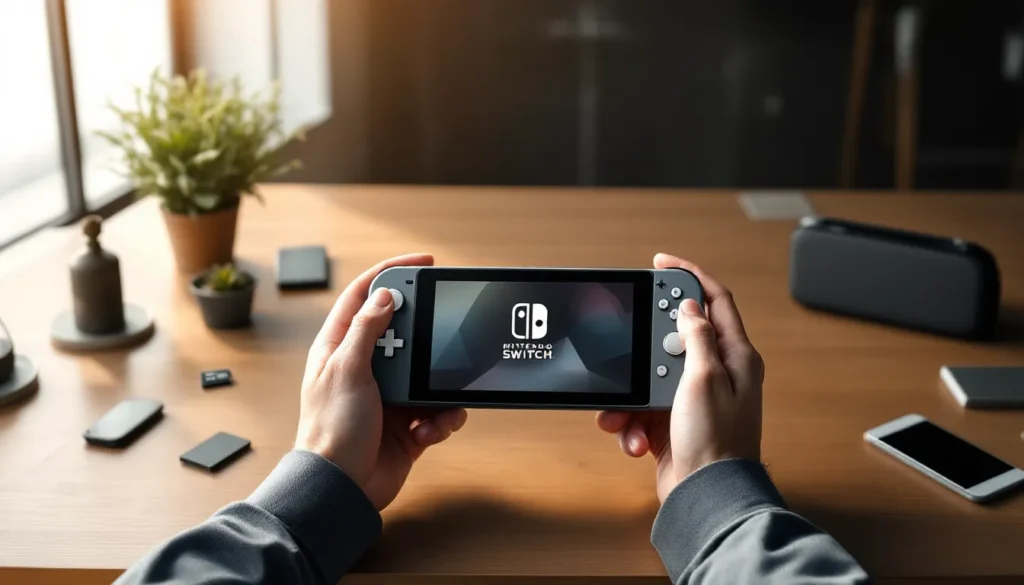
The Nintendo Switch Lite has been a solid entry point for handheld gaming since its 2019 launch, offering portability without the docking versatility of the full Switch. Now, rumors and leaks are swirling around Nintendo’s next move: the Nintendo Switch Lite 2. With the original console hitting its seventh year on the market, speculation about an upgraded handheld is hitting fever pitch. While Nintendo has remained officially tight-lipped, industry analysts and gaming insiders are painting a picture of what could be the company’s next handheld dominator. This guide breaks down everything we know, and what we’re expecting, about the Switch Lite 2 heading into 2026.
Key Takeaways
- The Nintendo Switch Lite 2 is expected to launch in early 2027 as a handheld-focused upgrade featuring a larger 5.8-inch OLED screen, improved battery life of 6-7 hours, and 25-30% better processing power than the original Lite.
- Nintendo Switch Lite 2 pricing is likely to land between $229-$279, with $249 as the most probable MSRP, positioning it as an affordable alternative to the $349 Switch OLED for handheld-only gamers.
- The Switch Lite 2 will offer 100% backward compatibility with all existing Switch games while featuring improved durability with a reinforced hinge mechanism and better cooling system to eliminate drift issues.
- Handheld-first gamers who value portability and extended battery life should consider upgrading to the Switch Lite 2, while TV-focused players should stick with the Switch OLED for its full docking capabilities.
- The Switch Lite 2 represents iterative hardware evolution rather than a generational leap, with realistic improvements in screen quality, performance, and battery life built on the proven handheld-only design philosophy.
What Is the Nintendo Switch Lite 2?
The Nintendo Switch Lite 2 is Nintendo’s rumored successor to the original Switch Lite, designed as a dedicated handheld gaming device with no docking capability. Unlike the standard Nintendo Switch, which connects to your TV, the Lite focuses purely on portable play. Think of it as the spiritual successor to the Game Boy lineage, focused, stripped down, and built for gaming on the go.
The original Switch Lite carved out its niche with a $199 price point and lightweight design. The Lite 2 is expected to follow a similar philosophy while bringing modern upgrades under the hood. Nintendo‘s strategy here isn’t about reinvention: it’s about iterative improvement. The company wants to offer a cheaper alternative to the full Switch and a more powerful option than the aging base model.
What makes the Switch Lite 2 different from the rumored “Switch 2” (the proper successor to the original Switch) is scope. The Switch 2 is expected to be a full generational leap with significantly increased power. The Lite 2, by contrast, is a mid-cycle refresh for Nintendo’s handheld-only audience. If you’re a portable-first gamer who doesn’t care about TV docking, the Lite 2 targets you directly.
Expected Release Date and Availability
As of March 2026, Nintendo hasn’t officially announced the Switch Lite 2. But, timeline speculation points to a potential announcement in late 2026, with a release window in early 2027. Some insiders suggest a reveal at Nintendo’s next major presentation or direct event, though this remains unconfirmed.
Historically, Nintendo releases new hardware in the spring or fall, avoiding major holiday market overlaps. Given that the original Switch Lite launched in September 2019, a similar window for the Lite 2 wouldn’t be surprising. Availability at major retailers, Best Buy, Walmart, Target, GameStop, and online through Nintendo’s eShop ecosystem, is virtually guaranteed whenever it drops.
One thing to watch: will Nintendo phase out the original Switch Lite? The company typically keeps older models available at lower price points for a year or two post-launch. This means you might see a $150-170 original Lite alongside a higher-priced Lite 2, giving budget-conscious buyers options. Platform availability will almost certainly be consistent across major regions (NA, EU, Japan), following Nintendo’s typical distribution strategy.
Design and Hardware Specifications
Screen and Display Features
The Nintendo Switch Lite 2’s display is rumored to jump to a 5.8-inch OLED panel, up from the original Lite’s 5.5-inch IPS LCD. This mirrors Nintendo’s successful OLED upgrade to the full Switch in 2021, deeper blacks, faster response times, and more vibrant colors. OLED tech is also more power-efficient than LCD, which could help with battery concerns.
Resolution is expected to remain 1280 x 720p, matching the current Lite. This isn’t a bottleneck: the resolution is solid for the screen size, and boosting it would drain battery faster without meaningful visual gains on a handheld screen. The higher refresh rate speculation (90Hz or 120Hz) is likely wishful thinking, Nintendo’s hardware philosophy prioritizes battery life and cost over cutting-edge specs. Expect 60Hz, the industry standard for Nintendo handhelds.
Brightness improvements are probable. The original Lite’s screen can get washed out in sunlight, and a brighter panel would address this common complaint. An anti-glare coating, like on the Switch OLED, is also a likely addition.
Processing Power and Performance Upgrades
The Lite 2 will almost certainly stick with a custom NVIDIA Tegra processor, the backbone of the entire Switch ecosystem. The exact chip remains unconfirmed, but expect improved performance over the original Lite’s SoC. Rumors suggest up to 25-30% better CPU and GPU performance, though nothing approaching “Switch 2” levels (which are rumored to be 8-10x more powerful).
RAM could increase from 4GB to 6GB, giving developers more breathing room for texture streaming and AI calculations. This wouldn’t be a massive leap, but it would allow for slightly more ambitious ports and cleaner performance. Storage speculation ranges from 64GB to 128GB internal, the original Lite has 32GB, which fills up quickly with larger games. An extra 64GB would be welcomed by anyone tired of SD card juggling.
Whether it supports current microSD cards or switches to a new standard (like microSD Express) remains unknown. Backward compatibility with existing Lite SD cards is likely a priority to avoid alienating current owners.
Battery Life and Build Quality
Battery capacity is expected to increase, though how much is unclear. The original Lite achieves 5-5.5 hours of sustained play under moderate load. The Lite 2 could push this to 6-7 hours, leveraging the improved efficiency of OLED and a larger battery (potentially 4000-4500 mAh, up from 3570 mAh). This is crucial, handheld gamers live and die by battery life.
Build quality improvements should include:
- Reinforced hinge mechanism (eliminating the drift issues that plagued early Switch units)
- Better cooling system to handle higher performance without thermal throttling
- Improved d-pad and button responsiveness
- Possibly textured back grip for better ergonomics
The original Lite’s design has proven durable, so don’t expect radical changes. Nintendo will refine, not overhaul. The Lite 2 will likely weigh slightly more than the original (210g vs. 275g currently) due to the larger battery and screen, but still be lighter than a full Switch.
Price and Pricing Strategy
Pricing is the billion-dollar question. The original Switch Lite launched at $199 in 2019. The current market is more saturated, the Switch OLED costs $349, and the base Switch has dropped to $249 on sales.
Realistic pricing for the Lite 2 ranges from $229 to $279. A $249 MSRP seems most likely, positioning it as a sweet spot between budget and premium. This gives Nintendo healthy margin while remaining accessible to its target audience: casual gamers and upgrades from the original Lite.
If Nintendo prices it too close to the Switch OLED ($299-349), the Lite 2 loses value, why not just pay an extra $50-100 for the TV docking option? If it’s too cheap ($199), it cannibalizes the original Lite’s installed base and suggests low-tier hardware.
Bundle pricing is almost certain. Expect the Lite 2 to ship with a popular title (likely a 2027 release like Pokémon Gen 10 or a major Mario game). Standing-alone units will also be available for flexibility. Nintendo’s strategy here is proven: bundles drive day-one adoption, standalone units capture the upgrade audience.
Regional pricing will vary by exchange rates and local market conditions. Japan might see a ¥20,000-22,000 price point (roughly $135-150), while EU pricing could hit €249-269 due to VAT.
Gaming Performance and Game Compatibility
Backward Compatibility With Existing Games
The Switch Lite 2 will be 100% backward compatible with the entire existing Switch Lite and Switch library. Nintendo has never broken backward compatibility within a generation, it’s a core pillar of their hardware strategy. Every game released for Switch, Switch OLED, and Switch Lite will run on the Lite 2.
What changes is performance. Games optimized for the base Switch might run smoother on the Lite 2’s improved hardware, better frame rates in demanding titles, faster load times, and more stable performance in CPU-intensive scenarios. Some developers might release patches to unlock higher frame rates or better visuals on the Lite 2, similar to what happened with the Switch OLED.
But, Nintendo likely won’t require developers to optimize specifically for Lite 2 hardware. The barrier to entry stays low. Smaller indie studios won’t need to allocate resources to Lite 2-specific tweaks: the game just runs better by default on better hardware.
Expected Launch Titles and Exclusive Features
Launch windows for new Nintendo hardware typically feature 2-4 major first-party titles. The Lite 2 could debut alongside:
- A major Pokémon title (Gen 10, likely releasing in late 2026)
- A new Mario franchise entry
- Possibly a Legend of Zelda spin-off
- Third-party highlights like upcoming ports or timed exclusives
Exclusive features are where things get interesting. The improved hardware might enable exclusive software enhancements that the original Switch and Switch Lite can’t handle. A theoretical Zelda spin-off could feature ray-traced lighting or complex physics simulations that only the Lite 2 can render. But, this is speculative: Nintendo rarely releases true exclusives that require newer hardware, they prefer inclusive design across their lineup.
A Lite 2-exclusive feature could be performance mode on legacy games. Imagine playing Breath of the Wild at a locked 60fps instead of 30fps, unlocked only on Lite 2 hardware. This incentivizes upgrades without fragmenting the player base.
How It Compares to the Original Switch Lite and Switch OLED
Original Switch Lite vs. Switch Lite 2:
The original Lite remains a fantastic value at its current $199 price point (or lower on sale). It’s proven, durable, and handles the entire library flawlessly. The Lite 2 improves the formula with a larger OLED screen, better battery, and more processing power, but at a $50+ premium. For budget gamers, the original Lite remains relevant. For anyone upgrading or buying new, the Lite 2 is the smarter long-term purchase.
Key differentiators:
- Screen: Lite 2’s OLED vs. Lite’s LCD is night-and-day for visuals and brightness
- Performance: Lite 2’s 25-30% faster processing helps with CPU-heavy games and load times
- Battery: Lite 2 expected to add 1-2 hours of playtime
- Durability: Lite 2’s improved hinge and cooling likely mean fewer hardware failures over time
Switch Lite 2 vs. Switch OLED:
This is the real battleground. The Switch OLED costs $349 and offers TV docking, handheld play, and tabletop mode. The Lite 2 will cost around $249 and offers pure handheld play with better specs than the original Lite but lower docking versatility than OLED.
The choice depends on lifestyle. If you primarily play docked on your TV or want flexible play modes, OLED wins. If you’re handheld-only or travel constantly, the Lite 2 is lighter, more affordable, and purpose-built for your needs. The Lite 2 won’t match the OLED’s dock features, but it’ll offer superior portability and a lower price tag.
Performance-wise, the OLED and original Switch use the same processor, any Lite 2 CPU bump might actually close the gap, though neither will rival the rumors surrounding the Switch 2. For games that demand raw power, wait for Switch 2. For everything else, the Lite 2 handles it.
Think of it this way: OLED is the Swiss Army knife. Lite 2 is the sleek pocket knife. Different tools for different gamers. Those who own a TV and want portability choose OLED. Those who live in their Switch and never dock choose Lite 2.
Should You Buy the Nintendo Switch Lite 2?
The answer depends on your situation:
Buy the Lite 2 if:
- You’re a handheld-only gamer who never docks
- You’re upgrading from an original Switch Lite and want the performance bump
- You value portability over TV connectivity
- You want the longest battery life possible on handheld hardware
- You’re a completionist who wants the latest Nintendo handheld tech
A longer battery means gaming sessions in the car, on flights, or during long commutes feel less rushed. The OLED screen is genuinely superior for reading UI text and enjoying visuals. The performance boost isn’t massive, but it’s noticeable in demanding ports and load-heavy games.
Skip the Lite 2 if:
- You own a Switch OLED and are happy with it (not worth a lateral move)
- You primarily play docked on your TV (get Switch OLED instead for full flexibility)
- You’re waiting for the Switch 2 and want a generational leap (patience is rewarded in 2-3 years)
- The original Lite is still meeting your needs (no shame here: it’s still solid hardware)
- You’re on a strict budget (watch for sales on the original Lite at $150-180)
The timing angle: If the Lite 2 launches in early 2027, buying now means you’re playing on 2019 hardware during the tail end of the Switch generation. If you can wait 6-12 months, the Lite 2 is the smarter buy for longevity. You’ll have support through the tail end of the Switch’s lifespan and potentially into early Switch 2 adoption as devs maintain both platforms.
One more thing: protect your investment with a quality screen protector and case. The Lite 2’s larger OLED screen is gorgeous but also more fragile than an IPS panel. Handling is everything on a device you’re carrying everywhere.
For competitive gamers or esports enthusiasts, the Lite 2’s performance boost and battery improvements could matter in marathon tournament sessions. Every frame and every hour of uptime counts when you’re grinding ranked matches on the go. Looking at how the hardware stacks up against existing systems, comparisons from major tech sites often highlight battery life and portability as differentiators for handheld devices, and the Lite 2 should excel in both categories.
If you’re serious about portable gaming in 2027 and beyond, the Lite 2 is worth the $249-279 investment. It’s not a revolution, it’s a smart evolution of proven hardware that gamers already love.
Conclusion
The Nintendo Switch Lite 2 represents Nintendo’s measured, iterative approach to hardware evolution. It won’t blow anyone away with raw specs, and it’s not supposed to. Instead, it refines the handheld formula with a better screen, improved performance, longer battery life, and more durable construction.
Whether it’s the right choice for you hinges on your gaming lifestyle. Pure handheld players will find it compelling. Gamers who value TV docking should stick with Switch OLED. Those hunting for a generational leap should wait for the Switch 2.
Rumors and leaks will continue swirling as 2026 progresses. Nintendo might surprise everyone with specs, features, or launch timing. Until official confirmation arrives, take all this as educated speculation based on historical patterns and industry insights. When the company finally reveals the Lite 2, you’ll have a solid framework for understanding how it fits into Nintendo’s broader ecosystem.